

Battery STC Installer Guide Pack
PART 1: INSTALLATION & ELIGIBILITY GUIDE
Overview
The Cheaper Home Batteries Program (CHBP) provides a federal subsidy for eligible battery systems through Small-scale Technology Certificates (STCs).
- Applies to systems commissioned on or after 1 July 2025
- Administered by the Clean Energy Regulator (CER)
Critical Eligibility Rules
Commissioning Definition
A system is commissioned when it has been tested to prove it is capable of charging and discharging energy.
- Must be commissioned AFTER PV is commissioned
- Do NOT test battery before PV and return later
- Commissioning date = Certificate of Compliance (CoC)
Audit & Compliance Risk
CER will scrutinise commissioning dates, especially around STC changes.
You must prove:
- Installer onsite on commissioning date
- System operational (charge + discharge)
- All evidence dates align
One System Per Premises is Eligible for BSTCs
A premises = typically one electricity meter (NMI)
- 1 meter = 1 battery eligible
- Multiple dwellings, 1 meter = 1 claim only
- Multiple dwellings, multiple NMIs = more than 1 claim
- You must supply evidence that each site is separately metered and billed
- Upload a copy of an electricity bill as evidence
NSW Rule: Currently the ability to claim PRCs for BESS1 (battery installs) has been suspended until further notice and cannot be combined with STC claims.
System Requirements
- 5–100 kWh nominal battery capacity
- The total battery capacity onsite must not exceed 100 kWh at the time of STC claim
- Max 50 kWh usable capacity eligible for STCs
- Create job for complete system capacity; only 50 kWh will be used to calculate STCs
Solar PV Requirements
- There must NOT be more than 100 kW of PV installed onsite at the time of claim
- There is no minimum PV size required to be eligible for battery STCs
- Must be CEC approved equipment
PV Requirement
- Must have existing OR new PV installed
- Battery-only installs where no PV is commissioned are NOT eligible
If no PV onsite → application fails and cannot be recreated
Off-Grid Battery Eligibility
Core Rule
Off-grid battery systems are eligible only when connected to a dwelling that is lived in and has its own solar PV system.
Eligible Off-Grid Dwellings
Additional off-grid batteries may be eligible at the same location (even if another battery has already claimed STCs) where the battery is installed in a separate, lived-in dwelling, such as:
- Tiny home
- Granny flat
- Houseboat
- Caravan
Conditions for Eligibility
All of the following must be met:
- The dwelling is lived in (not a structure)
- The dwelling is separate from the main residence or any dwelling that has already claimed STCs
- The dwelling has its own solar PV system
- The battery will remain installed until:
- After 2030, OR
- The end of the warranty period (whichever is later)
- The system meets:
- Off-grid battery requirements, OR
- has a VPP-capable inverter
Not Eligible
Structures that are not lived in are not eligible, including:
- Sheds
- Bore pumps
- Utility-only structures
Additional Evidence Requirements
In addition to standard STC evidence, you must provide:
- Clear photos of the dwelling where the battery is installed
- A map showing:
- The location of the dwelling
- Location of the main residence or other dwellings with battery claims
- Locations of any other dwellings claiming STCs
For mobile dwellings (e.g. caravans, houseboats):
- Map must show primary parked/moored location
- Provide vehicle or hull identification number
Install Limits
2 installs per day:
- 2 Solar PV only installs
- 2 battery-only installs (with existing PV already onsite)
- 1 Solar PV and 1 Battery install
SAA Exemptions
SAA exemptions fall into two distinct categories. It is critical you apply the correct type.
1. Standard Exemption – Multiple Sites per Address
Used when installing multiple systems at the same street address if more than 2 systems may be commissioned in one day where each system is associated with:
- Different unit numbers, OR
- Different lot numbers
This is a standard SAA exemption.
Full requirements and application process →Key requirements:
- Must apply BEFORE installation commences
- Applies to multi-dwelling or multi-site installations at same address
- Approval must be uploaded with STC application in Formbay
2. Special Consideration Exemption – Staged Installs
Applies only to staged installations conducted between 1 July 2025 – 22 December 2025.
- Must apply for special consideration through SAA
- Cost: $350 per application
- Must provide approval with STC submission in Formbay
Important Rules
- You must apply before the install commences (standard exemption)
- You must upload approval documentation to submit STCs in Formbay
- Without approval, applications may be rejected or unable to be processed
Serial Capture Rules
Always ensure you capture the Inverter nameplate, Battery master nameplate, and all Battery module nameplates to reduce risk of return to site.
| System Type | What to Scan |
|---|---|
| All-in-One Systems | 1 serial only = Inverter, master, and module |
| Modular with in-built inverter | Inverter = master; scan all modules |
| Separate systems | Inverter (existing or new) + BMU/BCU = master + scan all modules |
| BMU with capacity(e.g. FOXESS and ENERGIZER) | Scan as both master and module |
| Tesla Expansion | Scan lead unit as Inverter, master and module; scan any additional modules.** Adding to an existing system — create job as "Adding modules to existing system" |
Evidence Requirements
Required Photos
- Start photo
- Mid-install photo
- Completion photo
Photos Must Show
- Installer onsite
- System installed
- Nameplates and serials
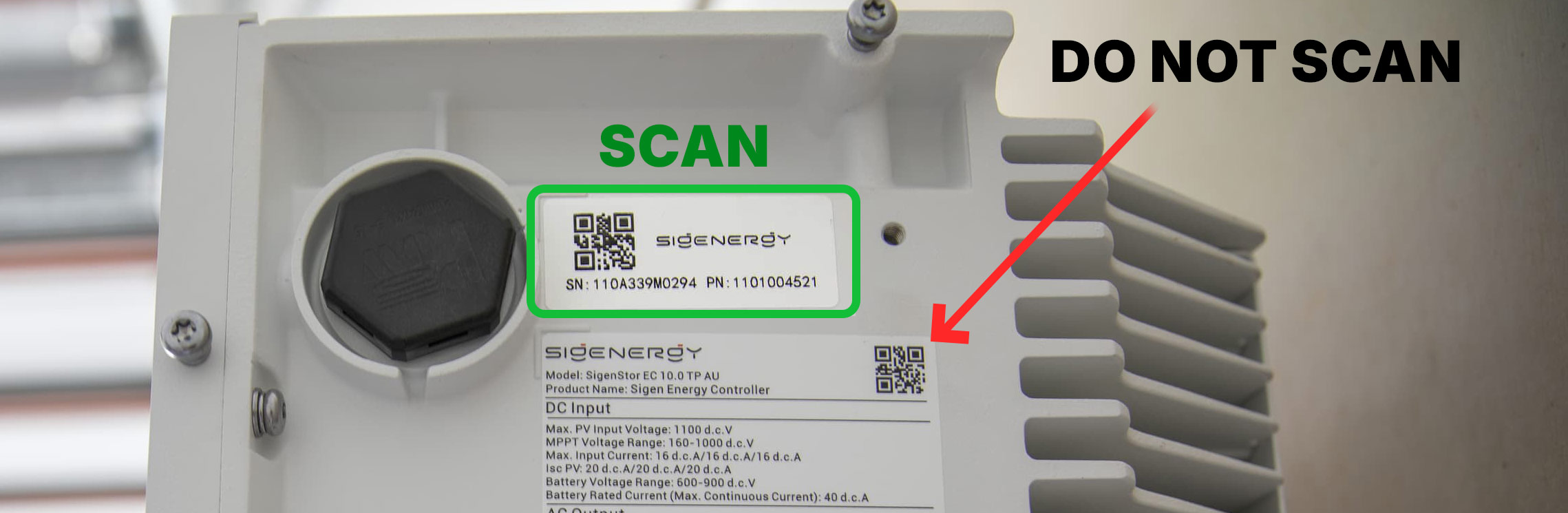
Sigenergy Notes
- Scan the QR code that corresponds to the SN (Serial Number)
- Do NOT scan QR codes located on the opposite side of modules
- You must capture a clear module nameplate photo
- Only CEC-approved Sigenergy configurations are eligible
- Always verify the full system configuration against the approved product list before submission
Top 10 Install Mistakes
- 1
Commissioning battery before PV
- 2
Testing battery early and returning later
- 3
Missing or incorrect serial numbers
- 4
Scanning wrong QR codes (Sigenergy)
- 5
No installer evidence on commissioning date
- 6
Mismatched CoC and install dates
- 7
Battery installed with no PV onsite
- 8
Incorrect system configuration listed
- 9
Not applying for SAA exemption before install
- 10
Poor quality photos — nameplates unreadable
Final Reminder
If a job fails due to eligibility issues:
- It may NOT be able to be recreated
- Installer may need to return to site
Accuracy at install time is critical.